
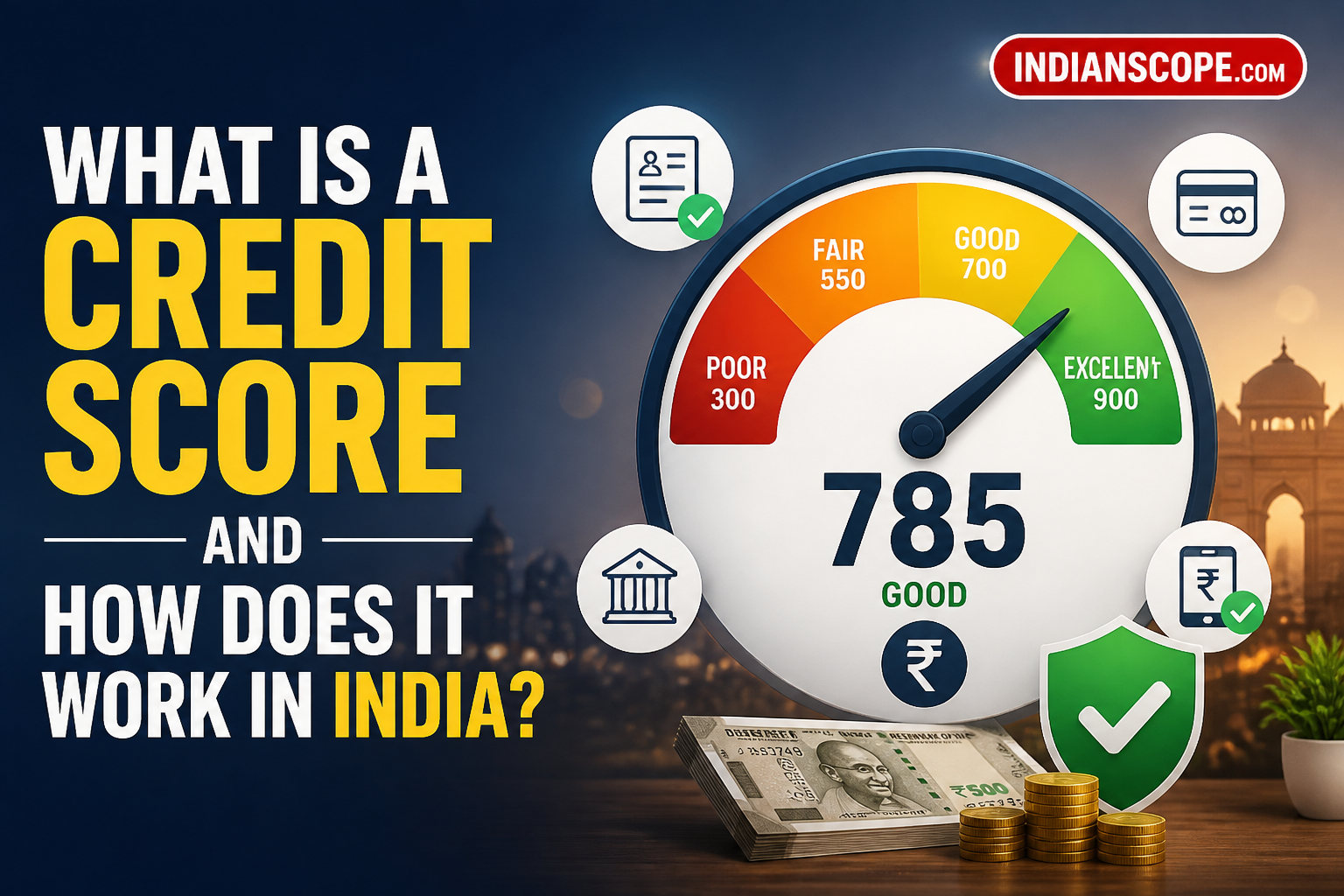
What is a credit score and how does it work in India? A credit score is a number calculated from information in your credit history. Lenders may use it as one indicator when assessing an application for a loan or credit card. It can help them understand how you have managed credit, but it does not decide approval on its own or guarantee a particular outcome. Your credit report contains the underlying account and repayment information; your score is a numerical summary derived from that record. The range and calculation can vary by credit bureau and scoring model, so a CIBIL Score is not a universal scale.
What is a credit score?
A credit score is a numerical summary based on information in a person’s credit history. It is intended to help lenders assess credit risk by offering a quick view of recorded borrowing and repayment patterns. It is not a complete picture of your finances or circumstances, and it is not a measure of your character.
A score can change when information in your credit history changes. Payments, account balances, new credit activity, and how long accounts have been reported may all be relevant. A score is therefore a snapshot based on available information and the scoring model used.
Credit score vs. credit report
A credit report is a record of credit accounts and related repayment information held by a credit bureau. A credit score is a number produced from information in that report using a scoring model.
The report contains details behind the number. If your score changes, reviewing the report may help you identify possible reasons, such as an updated balance or payment status. If information appears incorrect or unfamiliar, follow the relevant bureau’s process to request a correction. A score alone does not explain every factor behind a lending decision.
| Term | What it means |
|---|---|
| Credit report | A record of credit accounts and related repayment information. |
| Credit score | A numerical summary derived from credit-history information. |
| Credit bureau | An organisation that maintains credit information and produces reports and scores using its systems. |
The CIBIL Score range in India
TransUnion CIBIL describes its CIBIL Score as a three-digit number from 300 to 900, derived from information in a person’s credit history. This range applies to the CIBIL Score as described by CIBIL; it should not be assumed to apply to every bureau or scoring model. Different bureaus may use different models, and the same person may see different scores across services or at different times.
Interpret a score in context: consider which bureau produced it, when it was generated, and what information was available. Do not assume that two scores use identical calculations, or treat any single number as a promise that a loan or card application will be approved.
How lenders use a credit score
When you apply for credit, a lender may review information from a credit bureau as part of its assessment. The score can serve as one indicator of your past credit behaviour, while the report provides more detail. CIBIL states that its score is one input lenders may consider; it does not guarantee approval by itself.
Lenders make their own decisions and may consider other information relevant to their assessment, including their eligibility requirements and details of your application. A high score does not automatically mean approval, and a lower score does not explain the full reason for a decision. If an application is declined, ask the lender for the reason and check that your report is accurate.
Credit-history factors that can affect a score
TransUnion CIBIL identifies several factors relevant to a CIBIL Score. The exact weight assigned to each factor and the full calculation formula are not publicly specified in the cited material. Treat these as areas to understand, not as a formula for predicting a particular score.
Payment behaviour
Payment history shows whether credit obligations have been repaid as agreed. Missed or delayed payments may be reflected in your credit history and can affect a score. Paying bills and loan instalments by their due dates is a sensible way to maintain a reliable repayment record. Check statements and payment confirmations to ensure a payment is not mistakenly overlooked.
Credit utilisation
Credit utilisation is the proportion of available revolving credit, such as a credit-card limit, that is being used. For example, if a card has a limit of ₹1,00,000 and a reported balance of ₹30,000, utilisation based on those figures is 30%. CIBIL lists utilisation as a factor relevant to its score. This example explains the calculation; it is not a recommended target or a guarantee of a particular result.
Length of credit history
The length of credit history refers to how long credit accounts and related activity have been recorded. CIBIL identifies this as a relevant factor. A longer record may give a model more history to assess, but opening or keeping accounts solely to chase a score is not automatically beneficial. Consider whether an account suits your needs and whether you can manage it responsibly.
Credit mix
Credit mix refers to the types of credit shown in a person’s history. CIBIL includes credit mix among the factors relevant to its score. This does not mean you should take on a loan or card you do not need to create a particular mix. New borrowing creates repayment obligations, and credit mix alone does not guarantee a higher score or approval.
New credit enquiries
A credit enquiry is a record that a lender or other authorised party has requested information from a bureau in connection with a credit application or review. CIBIL identifies new credit enquiries as relevant to its score. Apply thoughtfully and avoid submitting applications you do not intend to pursue. Scoring models and circumstances can differ, so do not assume every enquiry has the same effect.
Responsible habits for building or maintaining a score
No habit can guarantee a specific score or loan approval. These practical steps can help keep your credit history in good order:
- Pay on time. Track due dates for card bills and loan instalments, and allow time for payments to be processed.
- Use credit within your means. Avoid borrowing more than you can repay and review card balances regularly.
- Check your credit report. Confirm that accounts, balances, and payment information look familiar and accurate.
- Address possible errors. If a report contains incorrect or unfamiliar information, contact the relevant bureau or lender through its official correction process.
- Apply selectively. Apply for credit when it meets a real need rather than submitting repeated applications without a clear plan.
- Be patient. Credit-history information builds over time. Short-term score changes do not always indicate a lasting problem or improvement.
Glossary of related terms
- Credit history: Information about credit accounts and repayment activity associated with a person.
- Credit report: A record of credit accounts and related repayment information used by a bureau to produce a score.
- Credit score: A number derived from credit-history information and used as one indicator in credit-risk assessment.
- Credit utilisation: The share of available revolving credit currently being used.
- Credit enquiry: A record of a bureau information request connected with an application or review.
- Credit bureau: An organisation that maintains credit information and provides reports or scores under its systems.
- Scoring model: The method a bureau or provider uses to turn credit-history information into a score. Models can differ, and the exact formula may not be public.
Conclusion
A credit score is a numerical summary of credit-history information, while a credit report shows more of the underlying record. In India, the CIBIL Score is one example, with a range CIBIL describes as 300 to 900; that range is not universal to every bureau or model. Lenders may consider a score alongside other information, so no number alone guarantees approval. Make repayments on time, manage borrowing carefully, apply selectively, and review your report for accuracy. These habits support a clear credit record but cannot guarantee a particular score or lending outcome.
Frequently asked questions
Is a credit score the same as a CIBIL Score?
No. A credit score is the general term for a number derived from credit-history information. CIBIL Score is TransUnion CIBIL’s score; other bureaus or scoring models may use different ranges or methods.
What is the CIBIL Score range?
TransUnion CIBIL describes its CIBIL Score as a three-digit number ranging from 300 to 900. Do not assume every bureau or scoring model uses the same range.
Does a good credit score guarantee a loan in India?
No. A score may be one input in a lender’s assessment, but it does not guarantee that an application will be approved. Lenders make their own decisions using information relevant to their process.
What can affect a CIBIL Score?
CIBIL identifies repayment history, credit utilisation, length of credit history, credit mix, and new credit enquiries as relevant factors. Exact factor weightings and the full calculation formula are not publicly specified in the cited material.
Does checking my credit report change my score?
The research used for this glossary does not establish how every bureau or report-checking service treats a consumer’s own check. Check the relevant bureau’s official guidance to understand the type of enquiry recorded in your circumstances.
How can I improve or maintain my credit score?
Pay credit obligations on time, use borrowing carefully, apply selectively, and review your report for errors. These are responsible habits, not a promise of a specific score or loan approval.
Why might scores from different services be different?
Credit bureaus and scoring models may differ, as can the information available and the date a score is generated. Compare the bureau, model, and date rather than assuming the numbers use an identical scale.